Schluter certified. TCNA member.
Restrooms, kitchens and cook lines set by certified installers, with waterproofing and substrate prep detailed to spec.
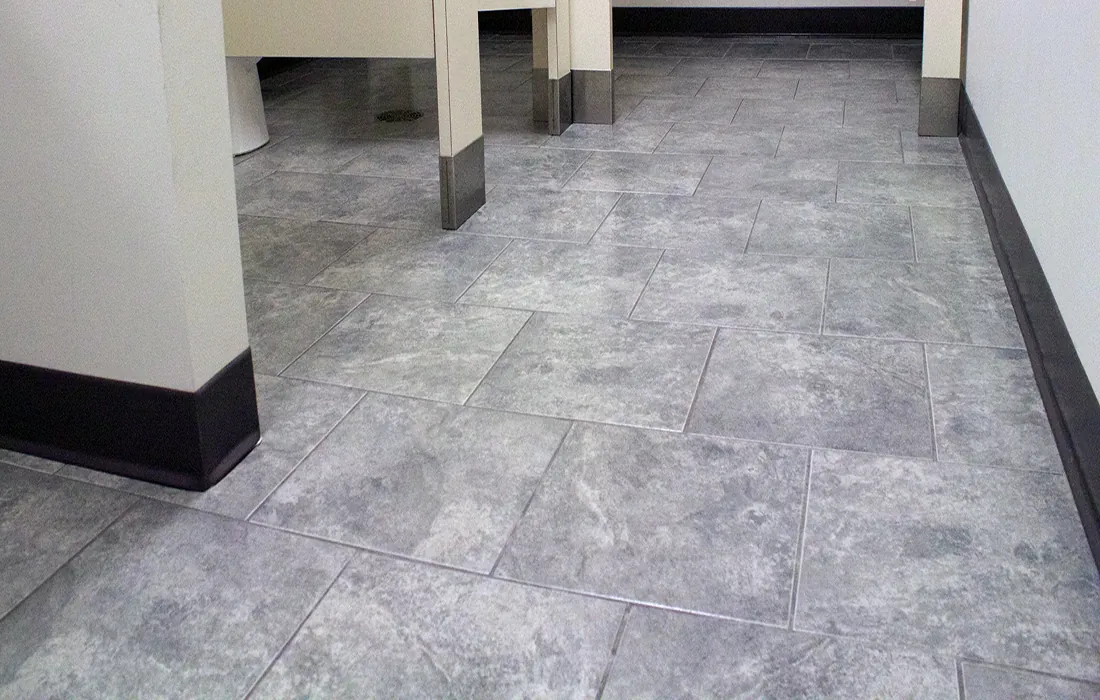
Ceramic and porcelain tile have been used in buildings for centuries. Materials, setting systems and waterproofing have advanced enormously, but the fundamentals of a successful installation haven't changed much — and some techniques in use today are the same ones used hundreds of years ago.
Properly specified and installed, tile is one of the most durable and timeless commercial surfaces available. It is also the most technically demanding flooring product to install correctly.
Schluter certified · TCNA member
Trade Mark Floors is certified in Schluter tile systems — one of only a handful of contractors in Louisville and the surrounding region holding that certification — and is an active member of the Tile Council of North America.
That matters because tile failures almost never originate in the tile. They originate in the assembly underneath it, and the assembly is what these certifications cover.
Modern tile assemblies incorporate specialized products and methods for waterproofing, uncoupling, crack isolation, movement accommodation, steam rooms, showers and wet areas, large-format tile, and floor and wall installations.
Substrate flatness: the numbers
Tile is unforgiving of an out-of-plane substrate, and the tolerance tightens as tile size increases. ANSI A108.02 sets the requirements:
Standard tile — all edges shorter than 15 inches: maximum variation of 1/4 inch in 10 feet and 1/16 inch in 1 foot from the required plane.
Large-format tile — at least one edge 15 inches or longer: maximum variation of 1/8 inch in 10 feet and 1/16 inch in 2 feet from the required plane.
Large-format porcelain is where most commercial tile projects run into trouble. A slab that would pass for a resilient floor will produce visible lippage under 24-inch tile. We evaluate and prepare substrates to the tolerance the specified tile actually requires — not a general one.
Unlike most flooring materials, tile installs on both floors and walls, which lets the same material family carry through a facility. The wall substrate has to meet flatness requirements too, and it's frequently overlooked.
Why correct installation matters
Tile must be installed to the requirements of the tile manufacturer, the setting-material manufacturer and the specified system. Improper installation contributes to cracked tile, cracked or failing grout, loose or debonded tile, lippage and inconsistent surfaces, pattern and layout problems, and moisture-related failures.
Nearly all of these originate beneath the finished tile — in substrate preparation, waterproofing, mortar coverage, movement joints and technique.
Wet areas, steam rooms & specialty systems
Trade Mark Floors is trained and experienced in wet-area installations, waterproofing systems, steam rooms and crack isolation.
These environments require far more than adhering tile to a surface. The complete assembly has to manage water, vapor and movement for the life of the building. A steam room is a vapor-drive problem before it is a tile problem.
Understanding the cost
Tile carries a higher initial installation cost than LVT, LVP, VCT or carpet tile. The reason is labor — depending on tile size, pattern, substrate condition and installation system, a commercial tile installation can require several times the labor hours of a resilient or modular floor.
That initial investment should be weighed against service life, water resistance and the fact that a properly installed tile floor can outlast several generations of resilient flooring in the same space.
Choosing a qualified tile contractor
Because the outcome depends so heavily on what happens under the tile, look for a contractor with manufacturer training, documented certifications and working knowledge of TCNA methods and ANSI standards.
Send us the prints.
Upload drawings and a scope and we'll send back a number — or call the office and talk it through.